The Traumatic Brain & Spine Injury (TBSI)
Trauma remains one of the leading causes of death and disability in Ethiopia, with neurotrauma—particularly traumatic brain injury (TBI)—being the most common and life-threatening form. It is also the most prevalent neurosurgical condition across the country.
Despite progress in establishing neurosurgical training centers, access to specialized care remains limited. The recommended global standard by the World Federation of Neurosurgical Societies (WFNS)—one neurosurgeon per 200,000 people—is still far from being achieved in Ethiopia. Many district hospitals lack neurosurgeons entirely, while others rely on just one or two specialists serving large populations.
As a result, general surgeons and surgical residents play a critical role in managing neurotrauma cases, often stepping in to perform emergency procedures when specialists are unavailable.
Why This Course
To address this urgent need, structured training is essential. The TBSI Course is designed to equip general surgeons and residents with:
- The ability to recognize life-threatening neurotrauma conditions
- Skills to perform emergency interventions such as burr holes and craniotomies
- Competence in stabilizing patients prior to referral or transfer
- Confidence to act decisively in high-pressure, time-sensitive situations
By strengthening these capabilities, the course contributes to reducing preventable deaths and long-term disabilities while building a more resilient trauma care system.
Overview
The Traumatic Brain & Spine Injury (TBSI) Course prepares regional general surgeons to assess, manage, and intervene effectively in cases of acute head and spine injuries.
Participants will develop and enhance:
- Cognitive skills – clinical knowledge and decision-making
- Management skills – patient assessment and care planning
- Technical skills – hands-on procedural competence
- Self-directed learning skills – continuous professional development
Learning Approach
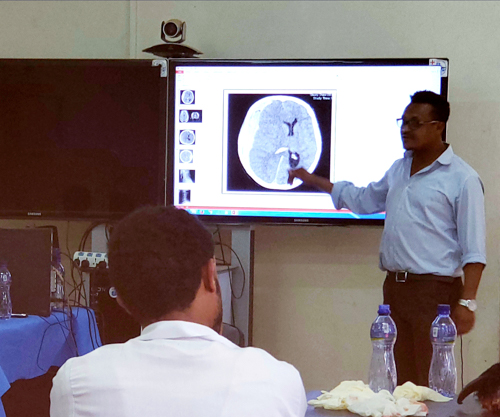
The TBSI Course combines modern, learner-centered methods to ensure effective skill development:
- Interactive lectures & presentations
- Socratic questioning and quizzes to deepen understanding
- Case-based learning for real-world clinical application
- Simulation-based training for technical skill development
The course emphasizes adult learning principles, encouraging active participation and independent learning.